You have probably heard this story at a pub quiz or on a FIFA loading screen. India qualified for the 1950 World Cup. The team refused to wear boots. FIFA showed them the door. It’s a great story. There’s just one problem. It is not what happened.
The real story comes from AIFF meeting records and years of research by football historians like the late Novy Kapadia. It’s stranger and more human than the myth.
Quick Answer
FIFA did not ban India from the 1950 World Cup for wanting to play barefoot. India withdrew because of the cost and logistics of traveling to Brazil, a lack of preparation time and the AIFF’s decision to prioritize the Olympics over the World Cup.
The Origin: London 1948 and “Bootball”
The legend actually begins in 1948, not 1950. A year after independence, India played its first international match against France at the London Olympics. Most of the squad took the pitch barefoot, or with their feet strapped in thin leather. They lost 2-1 and missed two penalties. Still, the performance stunned the London press. Captain Talimeren Ao is remembered for a line that summed up the contrast between the two teams:
“Well, you see, we play football, whereas you play bootball!”
It was a great line, and it stuck. Over the following decades, people read it as a manifesto. People assumed it was a stand the team would defend at all costs. It wasn’t. It was just how most Indian players had learned the game.
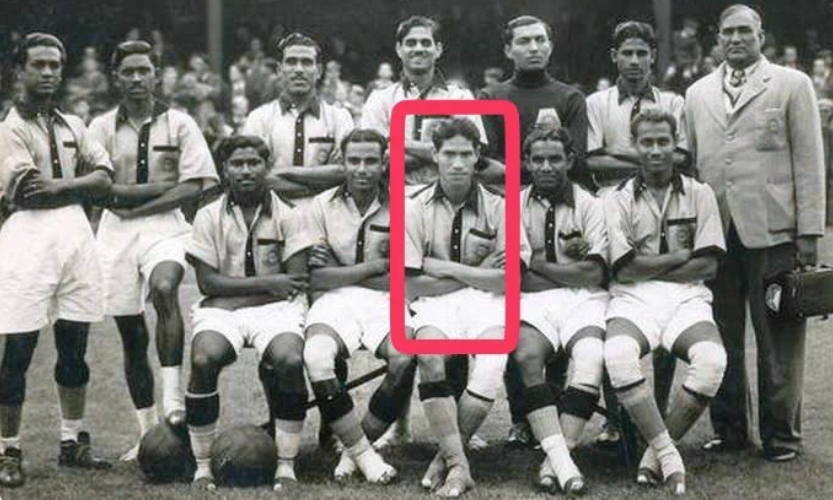
How India Qualified for the 1950 World Cup and Why They Never Went
Two years later, FIFA needed to fill a 16-team bracket for the first World Cup since the war, hosted in Brazil. India landed in an Asian qualifying group with Burma, Indonesia, and the Philippines. All three withdrew before a ball was kicked. India got a place in the tournament without playing a single qualifier. The 1950 Fifa World Cup India qualification remains the closest, the nation has ever come to appearing on football’s biggest stage.
AIFF’s own records, backed up later by historians like Novy Kapadia, point to three practical issues. None of them involve boots.
The Olympics mattered more. In 1950, the World Cup wasn’t the global institution it is today. India was a newly independent nation still finding its footing on the world stage, and the Olympics carried far more prestige. The AIFF treated the 1952 Helsinki Games as the real priority. There was also a real worry, however overcautious, that playing in a “professional” tournament like the World Cup could cost the squad their amateur status for the Olympics.
Money and logistics, though not quite in the way you’d expect. Money and logistics were part of the story, but not in the way most people assume. Shipping a squad from Kolkata to Rio was a serious undertaking. The AIFF estimated the trip would cost around ₹85,000. The host organizers actually offered to cover most of that bill. Football historian Novy Kapadia documented that Brazilian officials reached out to the AIFF( All India Football Federation) twice in early 1950, trying to secure India’s participation. So it wasn’t a lack of funds or options that held things up. It was the AIFF’s own indecision and slow paperwork. By the time a decision came, time had simply run out.
Time and team selection. The squad hadn’t trained together for anywhere near the length of time the trip demanded. Domestic tournaments like the Santosh Trophy meant state associations were reluctant to release their best players for months at a stretch.
What About the Boots, Then?
This is where the historical record gets a little messy. It’s worth being upfront about that instead of pretending there’s a clean answer. Some accounts say FIFA had no boots requirement in 1950 at all. They point out that India played barefoot again at the 1952 Helsinki Olympics without any objection. Other accounts say FIFA had already brought in a footwear rule after the 1948 Games. Both sides agree on the part that actually matters. Sailen Manna, India’s captain in the years that followed, later confirmed the squad was already training in leather boots to fall in line with international standards. He was clear that footwear was never the reason India stayed home.
The Cost India Paid for Missing the 1950 FIFA World Cup
FIFA ran the tournament with 13 teams instead of 16. The relationship between FIFA and the AIFF soured badly enough that India’s entry was flatly rejected for the very next World Cup, in Switzerland in 1954.
Indian football didn’t collapse after that. In fact, the opposite happened. Under coach Syed Abdul Rahim, the team entered a genuine golden era. India won Asian Games gold in 1951 and 1962. In 1956, they reached the semi-finals of the Melbourne Olympics, the first Asian team ever to do so, before finishing fourth. The World Cup door never reopened, though. India has never come as close to the finals since. The players who might have tested themselves against Sweden, Italy, and Paraguay in Brazil never got the chance to find out how they’d have measured up.
That’s the real sting in this story. India wasn’t barred at the gates over a pair of boots. A young federation, still learning what the World Cup would become, let a fully paid invitation quietly expire.
Enjoyed this story? For more deep dives into international football history, read our full feature on story of number 10.